Generatore di Titoli SEO YouTube
Start with the task. Save the work only if it is useful.
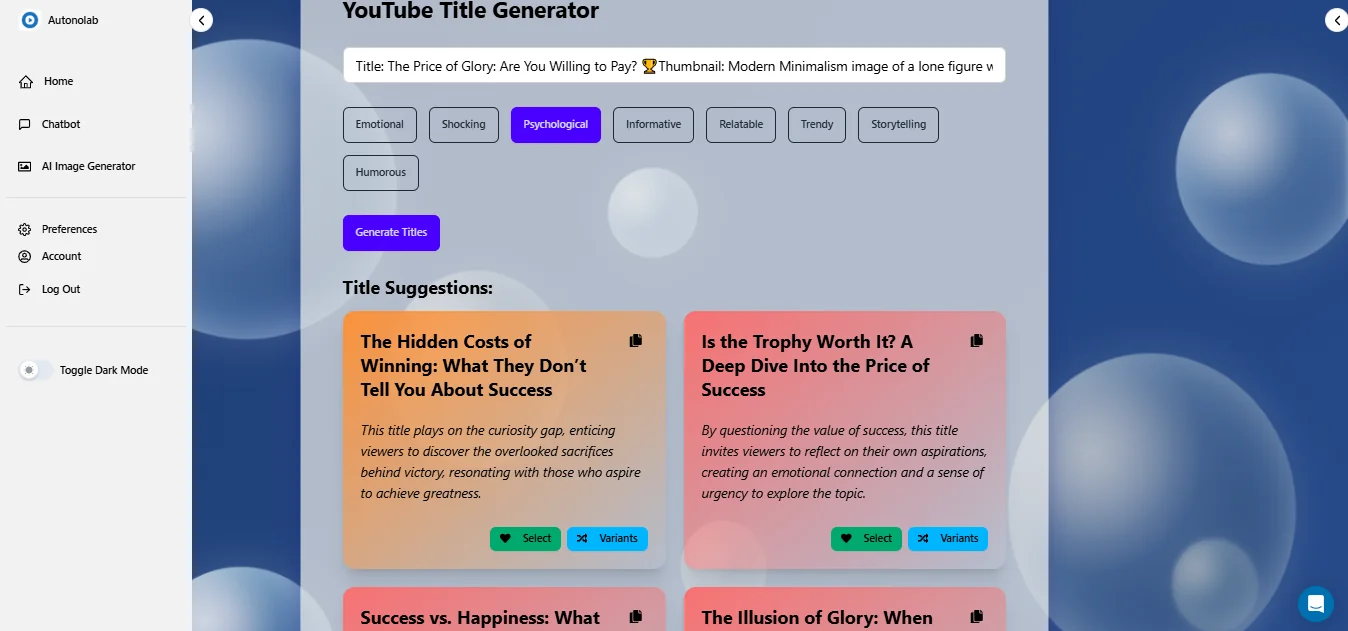
Watch demoTitoli Basati sui Dati
Titoli basati su schemi collaudati, non su parole casuali.
Abbiamo studiato i migliori creatori di contenuti per realizzare questo generatore intelligente.
Ricerca Intelligente di Titoli
Trova video di successo nella tua nicchia e analizza perché hanno funzionato per usarli come base.
Decostruzione Psicologica
Usa leve emotive e di curiosità per catturare l'attenzione e migliorare la percentuale di clic.
Segnali di Mercato in Tempo Reale
I titoli si basano sulla reale offerta e domanda attuale della tua nicchia di mercato.
Creato per i Creator
Ogni stile, ogni angolo.
Trova ganci emotivi, brecce di curiosità e altro, ideali per capire cosa piace ai tuoi iscritti.
Molteplici Stili Psicologici
Emotivo, scioccante, storie, umorismo: genera titoli secondo i migliori grilletti psicologici.
Generazione di Varianti
Ti piace un'idea? Crea varianti dello stesso titolo per eseguire dei test A/B.
Ottimizzato per SEO + CTR
Il bilanciamento ideale per l'algoritmo di YouTube e per spingere gli utenti a cliccare.
Consapevole della Strategia
Se hai un piano di crescita salvato, le idee si allineano con il tuo stile e posizionamento di marca.
Validato dai Numeri
Ogni proposta deriva dall'analisi delle performance reali della tua nicchia.
Strumento 100% Gratuito
Nessun limite o abbonamento richiesto. Genera idee di titoli gratis per tutti i tuoi video.
Unlock the Power of Stronger Titles.
Get click-worthy title ideas fast. Autonolab's Free AI Title Generator analyzes trending keywords, competitors, and video content to generate dozens of high-CTR titles for your videos.
Pro Title Writing Tips
Lead with the Promise
Front-load value - what will viewers get or learn? First 40 characters matter most for both humans and AI.
Play with Format
Listicle, question, hype, tutorial, challenge: try style variants and test what performs best.
Use Power Words
Words like "secret," "easy," "ultimate," "mistakes" create instant curiosity and drive up CTR.
Optimize, Don't Overstuff
Include at least one target keyword - but keep it clean. Curiosity-led titles trump spammy ones.
Want advanced strategies or real workflow breakdowns?
Dive into the Learning CenterThe best titles come from the best niches. Discover your next winning niche with our free YouTube Niche Finder.
Complete Your Optimization
Explore more AI-powered tools designed to help you dominate your niche.
Channel Audit & Strategy
Analyze your YouTube channel and get automated insights for growth.
Channel Analyzer
Deep dive into any YouTube channel's performance metrics.
AI YouTube Niche Finder
Discover profitable niches for your YouTube channel.
AI Channel Brand Kit
Generate channel names, positioning, bios, voice rules, and visual direction.
YouTube Outlier Finder
Identify viral opportunities by finding videos that outperformed channel averages.
AI YouTube Research Tool
Conduct deep research on any niche, topic, or competitor with AI-powered insights.
Upgrade Old Videos
Boost views on your old videos with fresh packaging and optimization.
AI Voiceover
Turn scripts into natural-sounding AI voiceovers for free.
Trending Content Discovery
Find data-backed ideas with AI-powered content gap analysis.
AI Script Editor
Craft engaging scripts and video ideas with AI assistance.
AI Editing Assistant
Get AI-powered scene suggestions and editing help for your videos.
AI Thumbnail Generator
Design pro thumbnails quickly with AI and creator-aware prompts.
Frequently Asked Questions About Autonolab
Want to keep this work connected?
Create a free workspace to save context and continue into projects.
More about this tool
Examples, background, and deeper explanation.
ShowHide
More about this tool
Examples, background, and deeper explanation.
Mastering Competitor & Channel Analysis with AI
Competitor research can reveal public patterns worth testing, but it cannot tell you exactly why another channel succeeds. Use public videos, packaging, publishing behavior, and audience comments to form hypotheses, then validate them against your own channel data.
1. The Secret Language of Tags and Metadata
Tags are supporting metadata, not a hidden growth lever. Our Competitor Tag Extractor turns a reference topic into precise entities, terminology, variants, and misspellings you may want to include when they genuinely describe the video.
2. Visual Psychology: Beyond Pretty Thumbnails
Thumbnails are part of the package viewers evaluate before clicking. Our Thumbnail Color Analyzer helps compare palette, contrast, hierarchy, and feed differentiation so you can plan a visual test. Color alone does not predict CTR.
3. Mining the "Gold" in Comment Sections
Competitor comments can reveal repeated questions, objections, confusion, and language worth investigating. The Comment Miner groups those signals into hypotheses for future videos; a comment pattern is evidence to test, not a blueprint for virality.
4. Diagnose the Viewer Experience, Not One Metric
The opening is where the title/thumbnail promise becomes an experience. Analyze Hook Strategy for promise confirmation, clarity, proof, stakes, and friction, then compare those hypotheses with your own retention data after publishing. No single script pattern guarantees distribution.